
How to Target Big Whitetails
By Kevin Wilson
Wondering how some hunters consistently tag big whitetails? Tired of experiencing ground shrink? Yes, it takes some learning, discipline, and even sacrifice. Hunting whitetails can be tough, but if you really want a challenge, set your sights on a big old mature buck. Settle for nothing less, play by the rules, and reality sets in quickly; it’s both a mental and a physical game. Here’s how to play it.
What Constitutes a Trophy-Class Whitetail?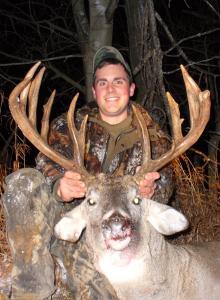
As a hunting guide and team member on Wild TV’s Bowzone Live, I have this conversation frequently. Most would suggest deer with big antlers. Here’s the thing though – not every big-antlered buck is mature. Likewise, not every old buck has big antlers. So, what really constitutes a big deer? Big antlers, a big body, or both? For me, a buck’s age holds a lot more weight. While some whitetail hunters might disagree, as a rule, a four-year-old is considered to be mature, but a five-year-old has clearly reached maturity. Combine both age and antlers that top the 140-inch mark and, you’re looking at a good buck. Better 150-inches, and that deer is even more impressive. Anything over the 160-inch threshold is awesome. Once a buck passes that magical Boone & Crockett (B&C) minimum of 170-inches, he’s in a whole different class of big. Relatively few whitetail hunters will ever kill one that big, particularly if they’re doing it by the book.
Where to Hunt Big Whitetails
Big bucks are where you find them, but your priority should be focusing on areas that hold healthy populations of genetically strong whitetails. In other words, places where whitetail populations haven’t been stunted by overharvest. A healthy herd has a high number of does, and a good representative age-class structure with lots of young bucks, i.e., one-to-three years of age, a good number of four-year-olds, enough five-year-olds to be noticeable, and bucks that are six and older. Add bucks with good antler mass and variable antler configurations, and these are indicators of a healthy herd. In my opinion, a buck-to-doe ratio of 2:1 is ideal, but rare.
Big whitetails are widely distributed throughout Alberta. From the mountains to the foothills, river bottom flats of the prairies, patchwork farmlands of the parkland, and the boreal forest – they are found from north to south and east to west.
Habitat matters. The biggest of the big bucks will invariably hone in on the best habitat with the best protein-rich food sources. Arguably, many hunters feel that their chances of tagging a big buck go up in the boreal forest. In many respects, they’re not wrong. On the other hand, I’m a huge fan of hunting the mixed forests of the parkland areas, but as far as highest odds go, forest fringe areas between agriculture and big timber can be big buck gold mines.
As a rule, big whitetails need safety (security), food, water, and access to does during the rut. A safe oasis for a big whitetail could be a small patch of timber or a massive expanse of forest, as long as he can avoid danger. I’ve seen 190-inch whitetails take up shop in the smallest cover simply because nothing bothered them there. As long as they aren’t harassed, during the warm summer months, they remain close to the best protein-rich food, and that often means places with clover or alfalfa. As fall approaches, they may shift to other prime food sources like canola, peas, corn, or barley crops. As harvest gets underway, velvet peals, antlers harden, and their movement patterns change.
Big Buck Habits
Big old mature whitetail bucks rarely do the same thing twice. They didn’t grow old by making mistakes. They innately know that routine makes them vulnerable. Most move under the cover of darkness, and the older they get, the less visible they become. As such, they’re masters at the game of hide and seek; that is, until the rut.
Best Opportunities
Certainly, big buck encounters happen throughout the season, however if you want to capitalize on the four best times to intercept a big one, here they are. The first few days of the early archery opener present a fantastic time to intercept a big mature whitetail on his feet during the first and last hour of each day.
The next best opportunity is during the late pre-rut, essentially the last week of October. Right around the 26th, is when primary scrapes become increasingly noticeable. Find a bigger, active, community scrape and hunt over it all day long during those days and your chances of encountering one of the bigger deer in the area go up as resident bucks visit and service these communication markers regularly at this time.
The next best opportunity is during the first estrus. In Alberta, all else being equal, the majority of does will go into heat for a 48 to 72-hour period between November 11th and 16th. This is when the bigger bucks get active and start throwing caution to the wind, exposing themselves and traveling hard around the clock. From the 17th to the 20th, while bucks are still traveling, it can sometimes seem like the bigger ones aren’t as visible as you might expect as they lockdown does to breed, but soon they’ll resume traveling hard once that window closes. The second estrus occurs 10 to 14-days later. Driven by photo-phase (daylight hours), November 21st and 26th can be truly magical for intercepting big bucks during daylight hours. This is when they really drop their guard traveling around the clock searching for late does in heat. Immediately after this window passes, the game is more or less winding down over by the last few days of the general November gun season.
Hunt Strategies
Every year, hunters get lucky and have a chance encounter with big bucks. They didn’t do anything special; it just happened. Some capitalize. Many don’t. If you really want to employ proven big buck hunt strategies, here’s how to do it. First recognize that, in order to score consistently on big bucks, you need to invest the time and effort. It requires commitment, especially if you’re hunting with a bow. In the pre-season, place trail cameras from July through to the end of the season – year-round is even better. The more intel you have, the more likely you’ll be to make good strategic decisions throughout the season.
Recognize that hunting tree stands or blinds in staging areas, on or close to, feeding areas may be your best opportunity during the initial days of the season, but once we get into the pre-rut and peak estrus periods, zero in on the highest density of does near primary scrapes. Funnels, or pinch points between wood lots are great places to sit and wait for a big whitetail.
If you’re rifle hunting, visibility is key. Set up on cutlines and cutline intersections with clear shot opportunities where does and bucks will be traveling across those is a proven strategy. If there’s heavy snowfall, does will be hitting the prime food sources, so hunting those fields and nearby transition areas will give you the highest chances to encounter a big buck. Aside from this, know that hunting big whitetails is a waiting game. It involves an academic understanding of where the big ones will most likely travel, and why – then waiting to ambush them when they show up.
Properly interpreting sign is important. Learn to differentiate between a primary and secondary scrape. Finding big rubs may show that a big deer was in the area, but pay less attention to those. Both bucks and does use primary scrapes to communicate during the pre-rut and through the peak estrus times. They need to visit them to determine if does are in heat. Invest the time, wait patiently, and it’ll eventually pay off.
Sidebar
As an added benefit, do yourself a favour and subscribe to the Moon Guide (App available through the App Store). Renowned trophy whitetail hunter, Adam Hays, swears by the Red Moon as prime times to be in the field pursuing big whitetails. I’ve been following the Moon Guide now for some time, and my own experiences coincide with those preached by Hays.