
Moon Phase & the Whitetail Rut
By Kevin Wilson
It’s no secret, lunar pull influences behavior in people and animals. The question is, to what extent, and how should it affect our decisions around when and where we hunt?
Given my career choice, I have the privilege of either guiding or hunting myself from late August through to mid-December. With that much time in the field, one can’t help but learn a thing or two about whitetails. Even still, they will humble even the most seasoned hunter in a hurry. For decades I’ve listened to old-timers talk about how deer movement slows during the full moon and, indeed, all else being equal, they generally head for cover earlier in the morning and out to feed a bit later in the evening … but there is more.
Intrigued with all-things-whitetail-deer, I’ve considered many theories over years, and have come to my own conclusions. My latest foray has been into the lunar cycle, and to what extent it does or doesn’t influence timing of the estrus. The late Charlie Alsheimer is best known for his moon phase theories. In fact, he made a reputation, not to mention a healthy living, as an outdoor communicator, largely based on his understanding of whitetail deer and the suggestion that moon phase significantly influences timing of the rut. Subsequently, I’ve also taken a dive into Adam Hayes’ MoonGuide and the Red Moon Days. More on this in a bit. For now, let’s take a look at how we can use lunar phase charts and whether or not this is merely theory or proven science.
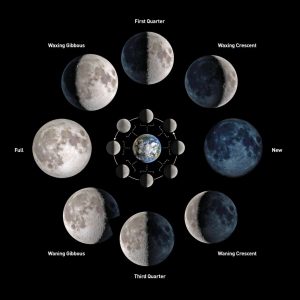
Lunar Phase Charts
Most of us pay at least some attention to moon phases. When we only have so many vacation days to hit the woods or waters, we like to tip the odds in our favor. To gain a clear understanding of the current lunar cycle, be sure to check this year’s moon phase chart. It’s easy to find online. Do a quick search and you’ll be able to correlate which days will see a New Moon, Waxing Crescent, First Quarter, Waxing Gibbous, Full Moon, Waning Gibbous, Third (or Last) Quarter, Waning Crescent, and then a New Moon again. Essentially, a Full Moon is when the moon is fully exposed, providing the brightest conditions illuminating a clear sky at night. All other phases identify to a greater or lesser extent, how much of the moon is covered or exposed – a cycle that repeats every 29.5 days.
Theory or Science?
I’m not a scientist, but I do know several esteemed wildlife biologists, each of them recognizes that moon phase clearly influences deer behavior. Where most draw the line however, is to what extent that behavior is influenced. Allow me to explain by sharing the results of a study led by Marcus Lashley, at North Carolina State University. He and his team of researchers monitored GPS-collared deer throughout the major moon phases, to assess when they moved most and least. Here’s what they found.
Most notably, with a New Moon, they recorded a peak in daylight morning movement, and below average activity the balance of the day. Similarly, with a New Moon, (when it’s dark), they recorded considerably less movement in the afternoons. Interestingly, they also determined that, during the First Quarter Moon (when it’s half-illuminated), deer moved less during daylight hours. But here’s the kicker. Contrary to traditional thought that deer move less during the daytime hours during a Full Moon, their research also identified that the opposite is true. Essentially, their data showed that deer move less at night during the Full Moon, and more during the day. As far as the Last Quarter Moon phase, their study also showed that Last Quarter Moon, and the five Waning Crescent days that follow give hunters the best opportunity to see early movement before dusk. To a great extent, and mostly from a citizen-science perspective, I can tell you that their findings concur with my own experiences – year after year in fact.
Here’s the problem though. As accurate as these scientific observations may be, with all else being equal, the one dynamic that remains constant is the timing of the first, second, and even third estrus periods. No doubt, visible deer movement can be either enhanced or suppressed by moon phase. The wrench in the whole thing though, is that many environmental factors can, and do, have similar influences. Hunting pressure, or intrusion, in a whitetail’s home turf, unseasonably warm conditions, even extreme cold will have an effect on movement. In turn, does may or may not get bred during their first estrus cycle.
So, this leaves us with that nagging question – is it scientific to definitively declare that lunar phase dictates when does will go into estrus. With all due respect for Alsheimer, and his closely followed rut theories, I say no, and so do the majority of learned deer biologists. My own deductions are based on over 40 years of observation and recording estrus cycles and movements in largely undisturbed wild deer. Ask learned biologists and they will tell you that estrus cycles are based on photo-phase. To be clear, it’s essentially a biological impossibility to have ruts occurring extraordinarily early or late. Logically then, it makes sense to acknowledge that there are many variables to consider, that it might even be irrational to stand firm on moon phase theories alone when discussing timing of the rut.
Photo-Phase Drives the estrus
If you’ve read my articles in the past, you’ve heard me say it before, and I’ll say it again. All else being equal, the timing of the whitetail rut is as perfect and precise as any natural phenomenon – and this past rut followed suit. In most situations, you can literally set your watch to it. Why? Because it is driven predominantly by daylight, or photo-phase, as opposed to moon phase. Prompted by the number of daylight hours, which by the way, are consistent and impeccably measured and published annually They are precise and reliable, just as the timing of the estrus is.
I’ve had this same conversation many folks across North America recently. I’ve discussed this very subject with other outdoor writers, and with other hunters as far north as New Jersey and as far south as Texas. Each asked when I thought that whitetails go into their first, second and third estrus cycles. Considering my own records along with a diverse network of professional outfitters and biologists, and I’m not shy about declaring precisely when these estrus cycles occur from the northern Canadian provinces down to the southern United States. For this reason, I’m particularly skeptical about the validity of moon phase theories as a sole dictator of estrus cycles.
So, despite the moon phase on any given year, if you want to hunt the peak estrus throughout the northern Canadian provinces and the north states, consider being in the woods between November 11 and 15 for round one. For the second estrus, don’t miss November 21-25. If you’re able to hunt an open season in December, it’ll be less defined, but with a little luck, you may witness an escalation in breeding action between December 4 and 8. Equally though, know that there are distinct exceptions once you get into some of the mid-eastern and southern states where rut cycles can be occurring in December and even January with some Texas whitetails. That said, given the odd mix of imported northern deer with indigenous whitetail populations, Texas whitetail rut cycles are all over the place from November through January. The important thing to note is that, whatever the naturally occurring rut cycles are in your area, they are triggered predominantly by photo-phase.
Adam Hayes’ II MoonGuide
I recently had the privilege of speaking with renowned whitetail bowhunter, Adam Hayes II. Owner of the MoonGuide App, he relies heavily on this tool; a great resource for hunting whitetails from late summer right through the rut. He uses it extensively for pre-season scouting, and for planning his local and out-of-state hunts. Along with other valuable tools, the MoonGuide calendar predicts the best days, times and locations to catch whitetails up and moving.
I started using this App myself last year and I can tell you it is remarkably accurate in predicting when deer are more likely to be on their feet. I’ve seen the Guide’s Red Moon Days align perfectly with some of my most successful hunts. Again though, remember there are always extraordinary variables that can, and often do, suppress deer movement. Recognize that the MoonGuide is a solid resource to supplement to address moon phase and higher-percentage times to be in the deer woods.
What’s the Verdict?
Indeed, to some extent, the verdict is still out. Does lunar phase affect deer movement? Clearly yes. Does it significantly influence when does go into estrus? No. With volumes of evidence suggesting otherwise, I’m a moon phase theory skeptic. Then again, that’s one of the mystical aspects of hunting the most secretive big game species on the planet. If we had all the answers, the game wouldn’t be half as fun to play.