
How to Run a Wolf Bait
Without a doubt, Alberta’s timber wolves are among our province’s most difficult predators to hunt. Ghost-like in their behavior, rarely are they seen. As an outfit, we see good success calling them in, but many of our guests prefer to hunt them over wolf bait. A word of caution though, no matter how you look at it, running a wolf bait takes time, money, patience, and strategy. If you’re thinking of giving it a try, here are a few things to consider.
Check the Regulations
Before you place a wolf bait, be sure to check your local regulations. Understand what you can use, when you can use it, and any other requirements like signage. For example, Alberta’s regulations outline that each bait site must have a readily observable sign showing the owner’s name, WIN number, or in the case of an outfitter or guide – their Big Game Outfitter Permit Number, or Big Game Guide’s Designation Number. Those running registered traplines of course have certain exemptions. And, these rules don’t apply if you are baiting wolves on private land.
Choose Your Location Wisely
One of your most critical decisions as you plan to establish a wolf bait will address location. To do this, it’s important to understand the tendencies, pack mentality, defense mechanisms, and territorial behaviour of wolves. Alberta’s wolf population is high. Abundant in our mountains, foothills, boreal forest and even many parkland WMUs, as a pack animal, they are particularly hard on moose, elk, wild sheep and other prey species.
Know that baiting, is by no means a guarantee. Just spontaneously dropping bait in a random spot could work, but your odds of attracting and holding wolves at that bait site go up if you choose a location where wolves routinely travel through. Wolves can have a bigger or smaller territory. It could be 25, 50, 75 square kilometres, or even more in size. They may circulate through the same locations every few days or even every 10 to 14 days.
Wolves, like other predatory wildlife, often favor ridges along waterways, and placing baits in smaller clearings or on smaller frozen lakes, even larger cutline intersections in known travel corridors can be excellent choices. For example, I have one at the end of a small lake just inside the mouth of a wide creek, adjacent to a beaver dam. I chose that particular location based on topography, and when I went to check it out the first time, there were fresh wolf tracks in the snow. I counted six different wolves in the pack and they’d literally gone through within the previous 24 hours. In turn, I set the bait right there and it is consistently active.
Baitsicles & Maintenance
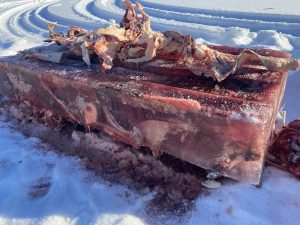 Unlike bear baiting, where the options are many and varied, wolves are easier to please. Beavers are a staple food source for wolves, so if you’ve got lots of carcasses, that’s a good choice. Alternatively, a butcher’s meat scrapes or road kill (e.g., deer, moose, elk found dead from vehicular collisions) are excellent choices. If you choose to use road kill, be sure to comply with provincial regulations requiring permits to pick these up. Also, know that they can only be used for bait if the animal died in the area that it will be used (contact your area Fish and Wildlife office for more information). A constant supply of meat or carrion will attract and hold wolves – at least for a time – throughout the cold winter months.
The blessing and curse of using meat though, is that it attracts other scavengers. On one hand, the noise of ravens at a bait serve to attract wolves that are in the area. On the other, scores of ravens, and coyotes can go through a lot of meat in a hurry.
In my experience, the best way to slow down the bait consumption is to freeze your meat in water. I like to pack my scraps into deep toboggans, then fill the sleds with water and let it freeze into a massive block or ‘baitsicle’. Although heavy, this makes it easier to tow behind a snowmobile or UTV. Similarly, on ice, I like to drill holes and freeze leg bones and rib cages directly into the ice, essentially locking the bait in place so that wolves need to stay and eat right where I want them to stand for a shot. Alternatively, if you set your bait on ice, by drilling shallow troughs, filling them with any loose pieces of bait, then drilling a hole to flood the trough, you can effectively establish another form of baitsicle that the wolves have to dig at to get at the food. Again, the biggest challenge is when the ice melts and meat is exposed. Scavengers quickly consume accessible pieces.
Positioning a Blind
The harsh reality check in all of this is, that most hunters will spend hundreds of hours waiting in a blind, and most often never even see one during daylight hours. If you’re up for it though, strategically placing a box or pop-up blind 150 to 200 metres downwind of the bait is a good bet. Know that wolves will always be looking for a reason to leave, so do everything possible to avoid leaving human scent on any trails to or from the bait, or at the bait site itself. I know guys who will literally pull their bait in on a snowmobile, and drop it off without ever even stepping off of their machine for fear of leaving human scent. I’ve seen good success using a portable pop-up blind and covering it with layers of spruce boughs and logs, leaving only a small opening watch and shoot through.
Set Trail Cams
I can’t stress this enough. When possible, use wifi trail cams. It will save you a ton of fuel, help you avoid leaving human scent at the bait site, and let you know when wolves are visiting. Most importantly, it will let you know if wolves are coming during legal light. Most are careful and visit under low light conditions or under the cover of darkness. Having the ability to determine if, and when, they’re visiting in daylight is critical intel.
While there’s never a guarantee, in my experience, when wolves visit a wolf bait site, as long as there is quality meat for them, they will often stay in the area for a few days, then move on. If you can sit your wolf bait as soon as wolves show up, your odds of getting a shot opportunity go way up.